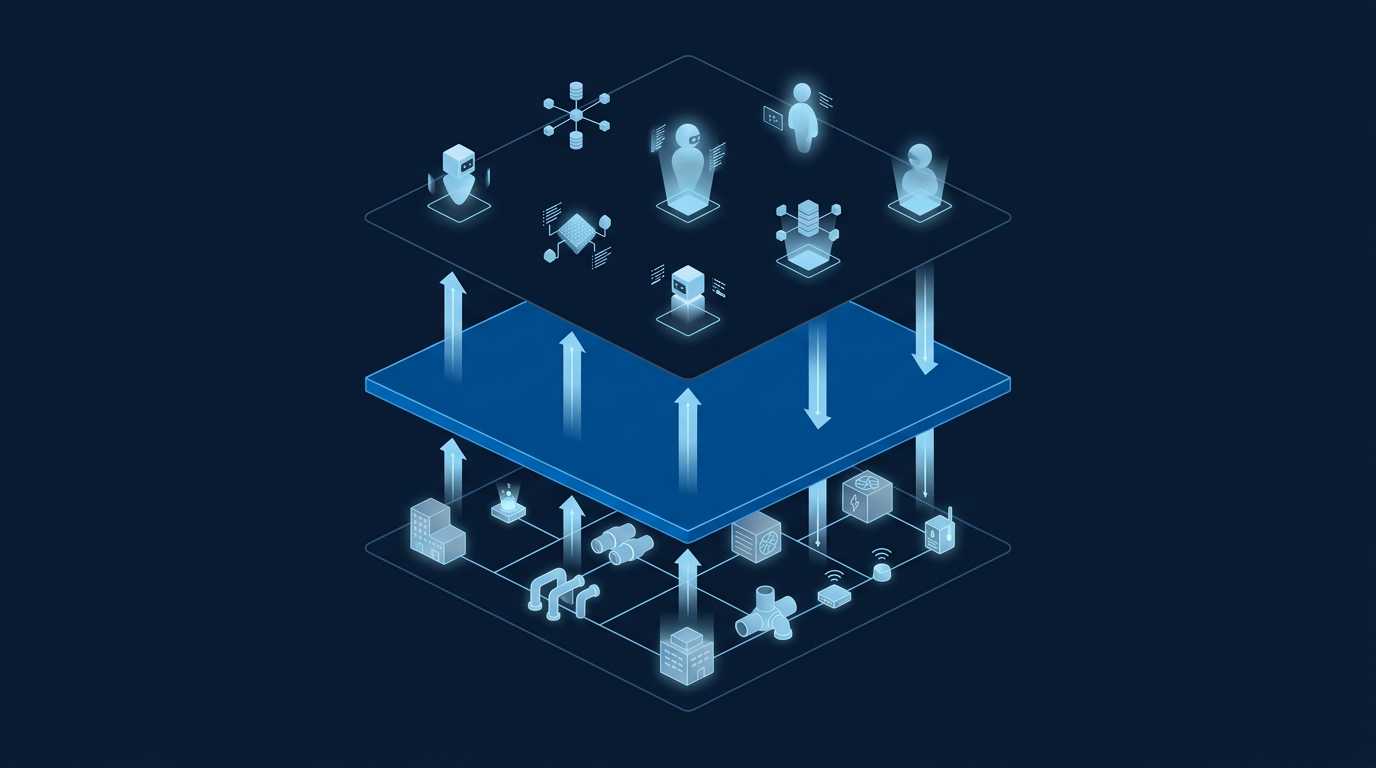
Scroll to see the stack build from physical infrastructure up to the economic layer. Click any layer to explore.
Immutable audit trails, asset registry, tokenized incentives, and financial intelligence.
Every agent action, transaction, and performance metric is cryptographically logged on-chain. Asset owners get a tamper-proof operational history that feeds directly into financing, insurance, and compliance workflows.
Agent-driven procurement, provider matching, smart contract settlement, and outcome verification.
Agents autonomously identify maintenance needs, match with qualified service providers, negotiate scope and pricing, and verify completion — closing the loop from insight to work order to verified outcome.
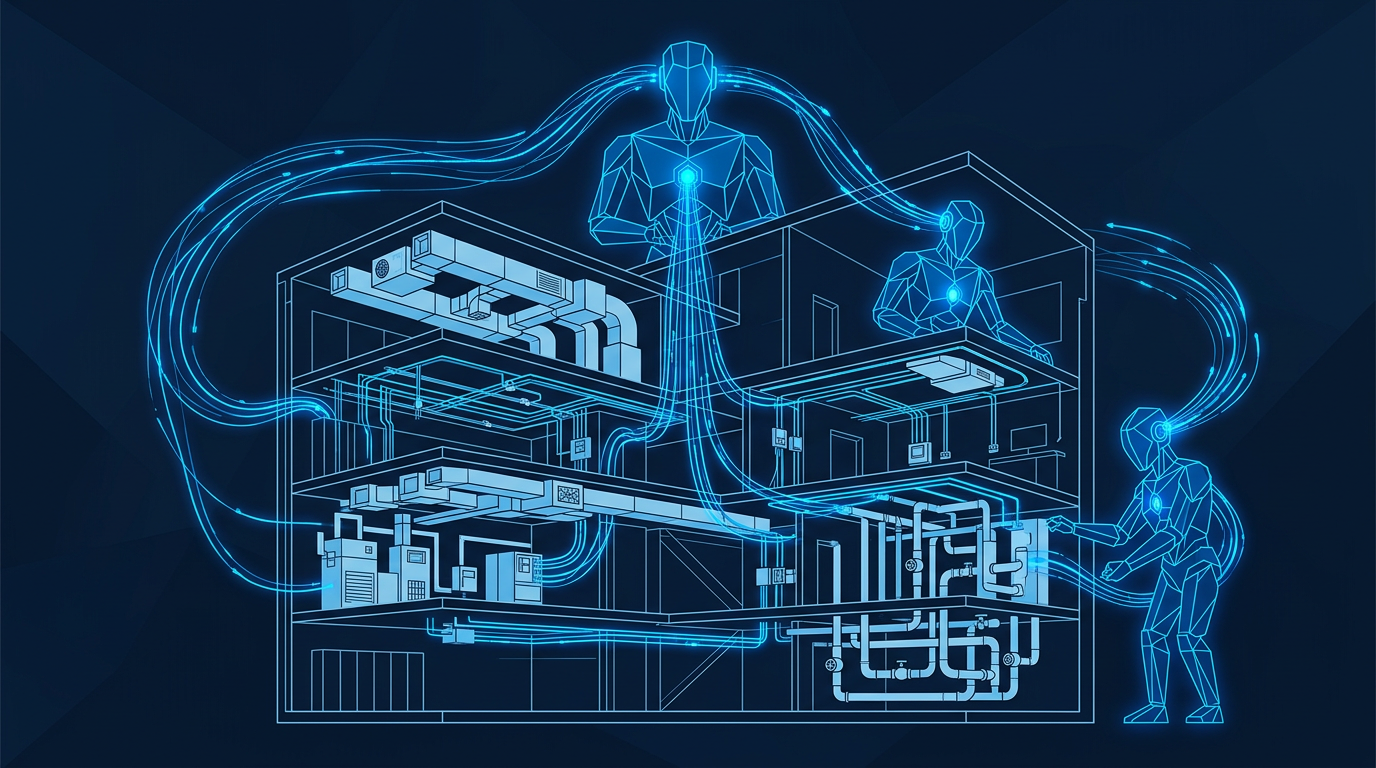
Specialized AI agents trained on decades of infrastructure expertise across every domain.
Energy, HVAC, maintenance, security, fire protection, lifecycle planning — each domain has purpose-built agents that encode decades of engineering expertise. They coordinate laterally, not in silos.
The orchestration engine, autonomy governance, communication bus, and policy enforcement layer.
The core runtime. Manages agent lifecycle, inter-agent communication, policy enforcement, autonomy tier governance, and audit logging. Every agent runs through this layer — nothing operates outside governance.
Domain ontologies, reasoning models, digital twin simulators, and agent training pipelines.
The knowledge backbone. Domain ontologies map building systems; digital twins simulate scenarios before agents act; reasoning models make decisions explainable; training pipelines continuously improve agent performance.
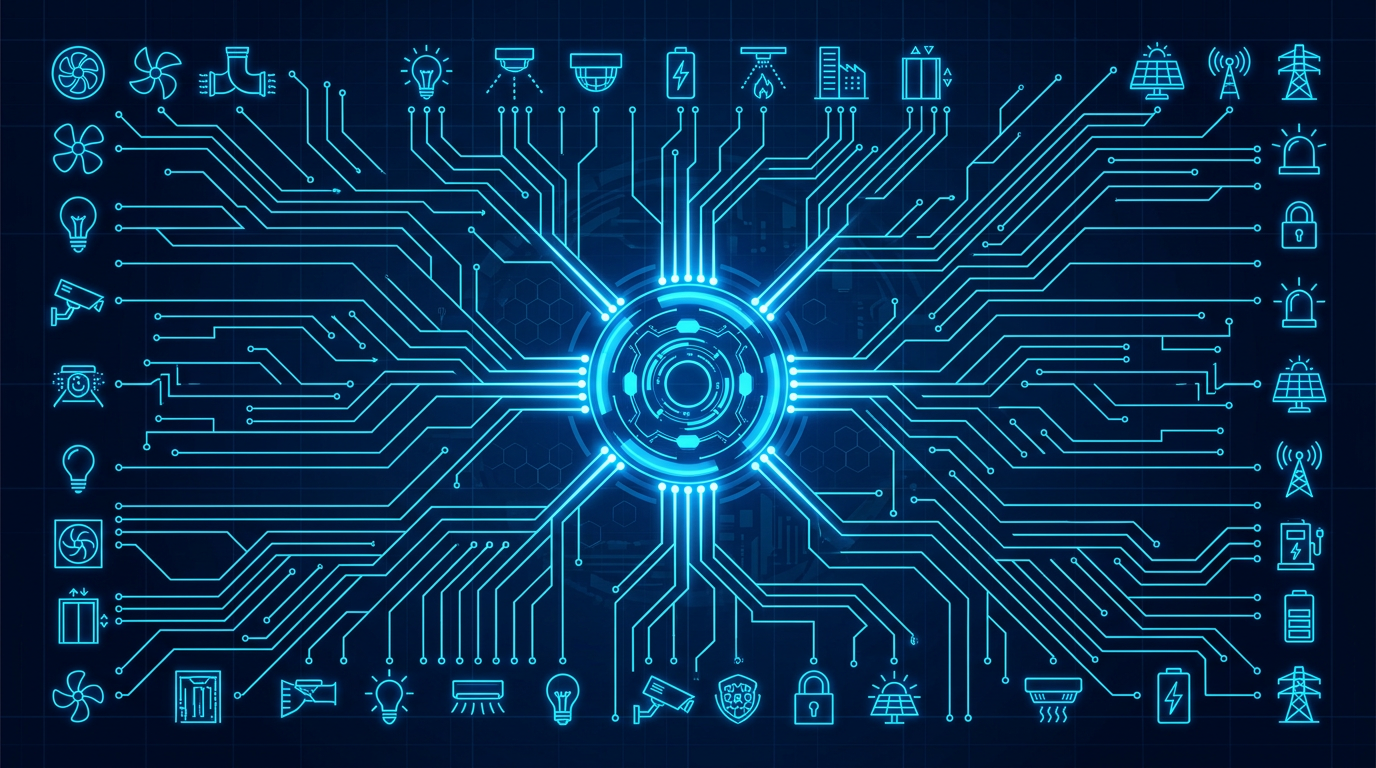
IoT sensors, BMS/SCADA systems, edge compute gateways, and real-time data streams.
Connects to existing building protocols — BACnet, Modbus, OPC-UA, MQTT, REST APIs. Edge gateways process data locally before sending to the OS. No rip-and-replace; bridges what you already have.
Buildings, campuses, cities, transport networks, and the sensors/actuators within them.
The built environment itself. Commercial buildings, data centers, industrial plants, campuses, city infrastructure, and all the mechanical, electrical, and plumbing systems within them.
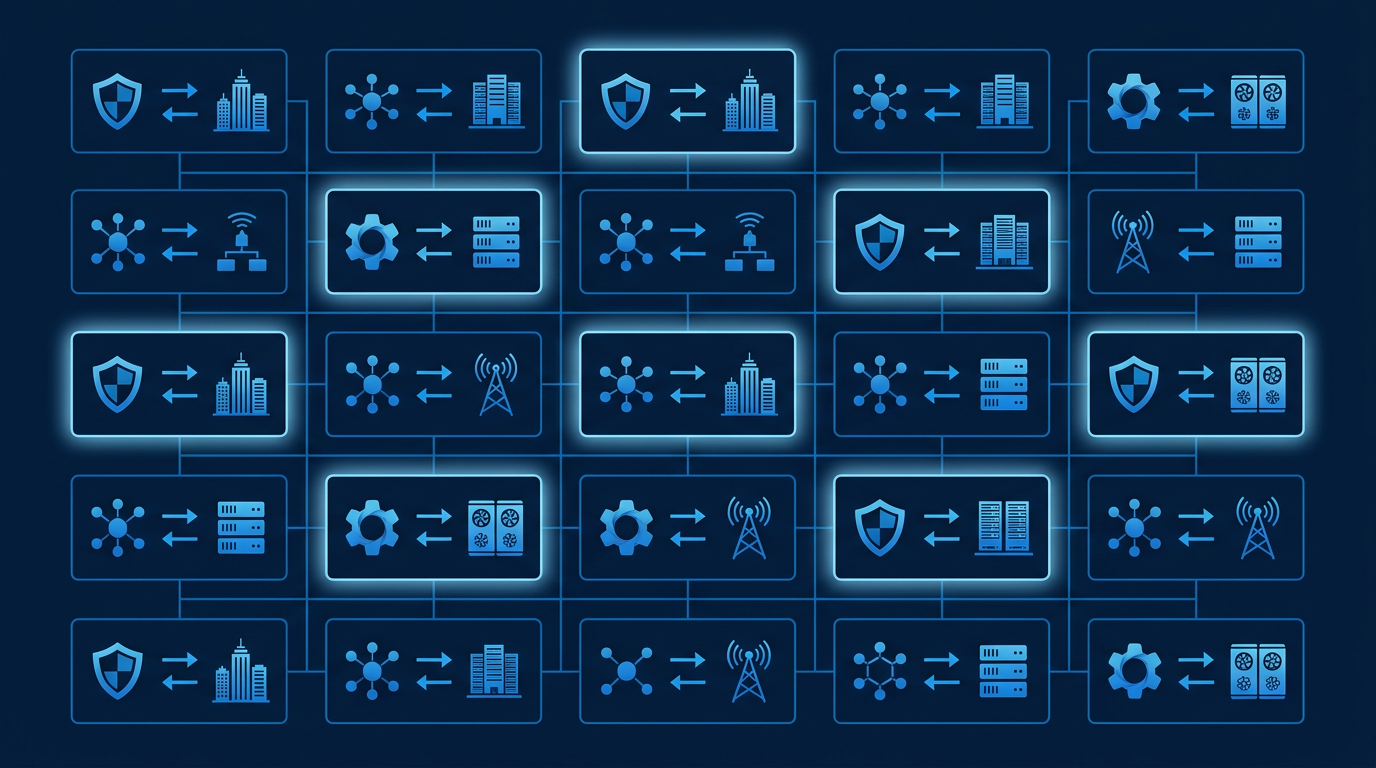
Click any node to explore. GAOS sits at the center — every capability connects through it.
Create, schedule, monitor, and recover agents safely across sites.
A single interface for BAS, SCADA, IoT, meters, and enterprise IT.
Delegation, negotiation, and goal tracking across domains.
Role-based access, policy enforcement, and full audit trails.
Tokenized incentives, usage-based pricing, and M2M transactions.
Infrastructure AI doesn't ask you to hand over control on day one. GAOS enables a progressive journey — from passive monitoring to full autonomous operations — at whatever pace your organization is ready for.
Passive monitoring. Agents watch systems and collect data without taking action.
Agents analyze data and recommend actions. Humans approve every decision.
Agents act within defined policies. Humans monitor via the Agent Observatory.
Agents operate autonomously within boundaries. Escalation to human only for edge cases.
Full autonomy. Agents continuously optimize, transact, and adapt. Humans set outcomes and review performance.
Infrastructure AI's Galaxy Agentic Operating System (GAOS) will soon be available for Public Beta.
Want to see autonomous agents run a building in real time?
Launch our interactive demo — no signup required.